Lesson Friday September 20th
During today’s lesson it’s demonstrated how you to use the force method for statically indeterminate problems which only involve extension
Demonstration
Given a structure as shown below:
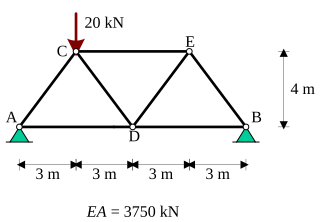
Structure
We can find the normal force distribution using the force method. Therefore, we need to know the degree of statically determinacy. The free-body-diagram of the full structure is as follows:
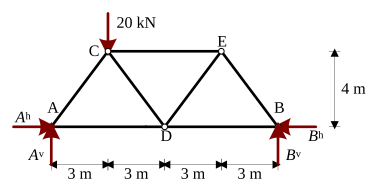
Free-body-diagram full structure
There are 4 unknown support reactions. With only 3 equilibrium equations for this self-contained structure, it can be concluded that this structure is a first-order statically determinant structure.
To apply the force method we need to replace a part of the structure by a statically indeterminate force, which turns the structure into a statically determinate structure. To solve the statically indeterminate structure we need to include a compatibility condition.
Define statically determinate structure with compatibility condition
In this structure, we choose to replace the right support with a rolling hinged support. This leads to a horizontal statically indeterminate force with the compatibility conditions :
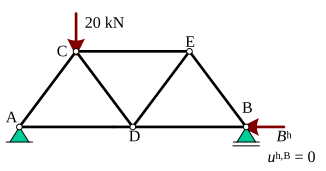
Statically determinate structure with compatibility condition
Solve displacements statically determinate structure in terms of statically indeterminate force
The force distribution and displacements in this statically determinate structure is now solved for in terms of .
Support reactions
First, the support reactions are solved for
Free-body-diagram full structure
Leading to:
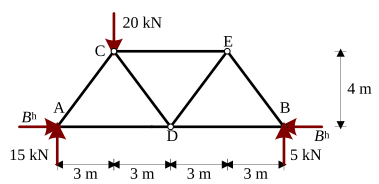
Free-body-diagram full structure with resulting support reactions
Section forces
The section forces are solved for, starting with the forces in and :
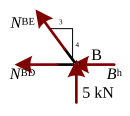
Free-body-diagram joint
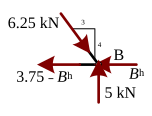
Free-body-diagram joint with resulting sections forces
Now, let’s continue with a section through beams , and :
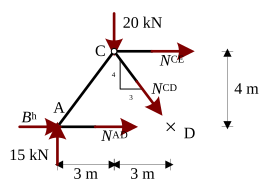
Free-body-diagram part
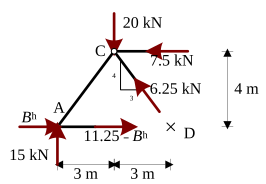
Free-body-diagram part with resulting section forces
Thirdly, let’s continue with the joint :
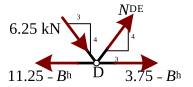
Free-body-diagram joint
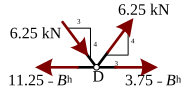
Free-body-diagram joint
And finally joint :
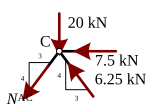
Free-body-diagram joint
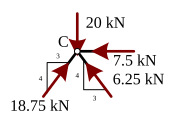
Free-body-diagram joint
Shortening/lengthening of elements
Now, for each element the shortening / lengthening can be calculated:
Displacement structure due to 
For now we’ll ignore the shortening/lengethening due to :
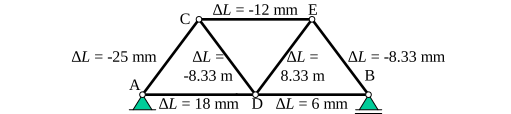
Shortening/lengthening of elements
This gives the following Williot-diagram with a fixed :
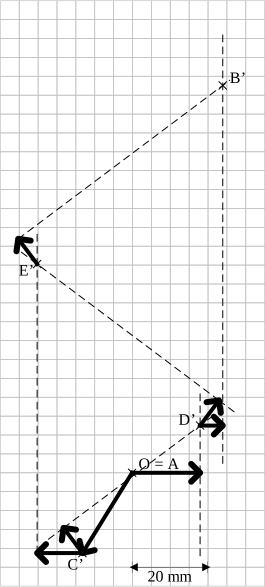
Williot diagram with fixed
Leading to the following displacements if doesn’t rotate:
| joint | Displacement due to with fixed in horizontal direction → | Displacement due to with fixed = in vertical direction ↓ |
|---|---|---|
| 0 | 0 | |
| -13 | 21 | |
| 18 | -12.5 | |
| -25 | -55 | |
| 24 | -103 |
shouldn’t move vertically, so this structure has to be rotated back with ⟳, leading to:
| joint | Displacement due to θ in horizontal direction → | Displacement due to θ in vertical direction ↓ |
|---|---|---|
| 0 | 0 | |
| 34 | 26 | |
| 0 | 51 | |
| 34 | 77 | |
| 0 | 103 |
Resulting in total displacements of:
| joint | Displacement due to in horizontal direction → | Displacement in vertical direction ↓ |
|---|---|---|
| 0 | 0 | |
| 21 | 47 | |
| 18 | 39 | |
| 9 | 22 | |
| 24 | 0 |
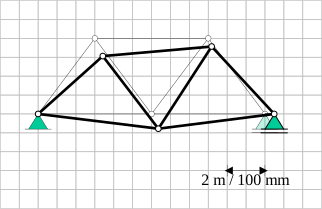
Displaced structure
Displacement structure due to 
For the displacement due to in , the following Williot-diagram with a fixed can be drawn:
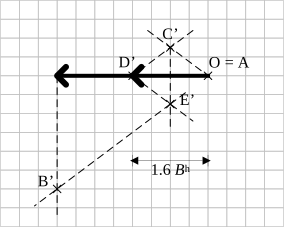
Williot diagram with fixed
Leading to the following displacements if doesn’t rotate:
| joint | Displacement due to in horizontal direction → | Displacement due to in vertical direction ↓ |
|---|---|---|
| 0 | 0 | |
| 0 | ||
Again, Shouldn’t move vertically, so this structure has to be rotated back with ⟲, leading to:
| joint | Displacement due to θ in horizontal direction → | Displacement due to θ in vertical direction ↓ |
|---|---|---|
| 0 | 0 | |
| 0 | ||
| 0 |
Resulting in total displacements of:
| joint | Displacement due to in horizontal direction → | Displacement in vertical direction ↓ |
|---|---|---|
| 0 | 0 | |
| 0 |
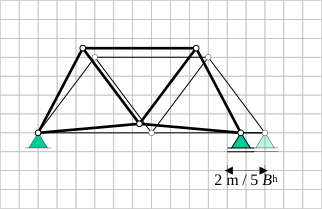
Displaced structure
Solve statically indeterminate structure with compatibility conditions
Now, we can fill in the compatibility conditions:
Section forces statically indeterminate structure
The section forces can be calculated by filling in the resulting in our previous expressions:
| Element | Normal force |
|---|---|
| -18.75 | |
| -7.5 | |
| -6.25 | |
| -6.25 | |
| 6.25 | |
| 3.75 | |
| -3.75 |
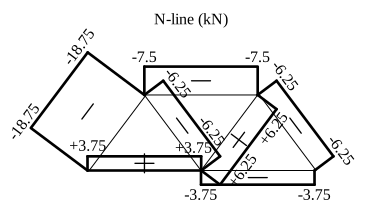
Normal force distribution
Displacements statically indeterminate structure
Now, the displacements can be found as well by filling in the resulting in our previous expressions:
| joint | Displacement in horizontal direction → | Displacement in vertical direction ↓ |
|---|---|---|
| 0 | 0 | |
| 9 | 38 | |
| 6 | 29.833 | |
| -3 | 12.66 | |
| 0 | 0 |
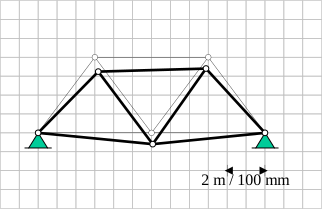
Displaced structure