During today’s lesson it’s demonstrated how you to use the force method for statically indeterminate problems which only involve bending
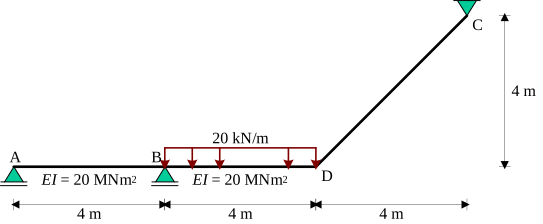
Demonstration ¶ Given a structure as shown below:
Structure
We’ll apply the force method, specifically, the ‘hoekveranderingsvergelijkingen’.
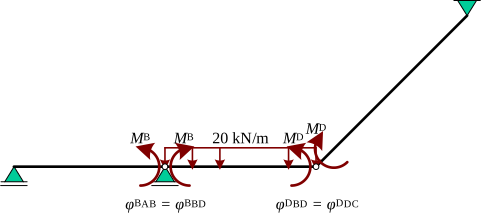
Define mechanism compatibility conditions ¶ To apply the ‘hoekveranderingsvergelijkingen’, we apply hinges, with statically indeterminate moments M B M_\text{B} M B M D M_\text{D} M D φ B A B = φ B B D \varphi _{\rm{B}}^{{\rm{AB}}} = \varphi _{\rm{B}}^{{\rm{BD}}} φ B AB = φ B BD φ D B D = φ D D C \varphi _{\rm{D}}^{{\rm{BD}}} = \varphi _{\rm{D}}^{{\rm{DC}}} φ D BD = φ D DC
Mechanism with compatibility conditions
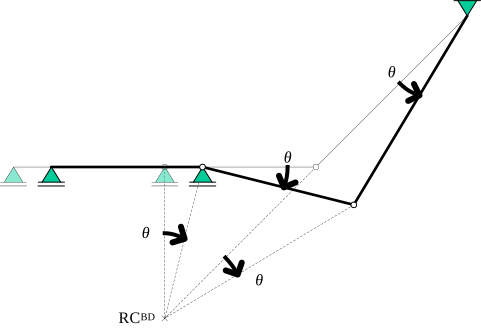
The structure has now become a mechanism, which will lead to rigid body rotations next to the bending. The deformation due to the rigid body rotations of the mechanism can be found as:
Deformation mechanisms
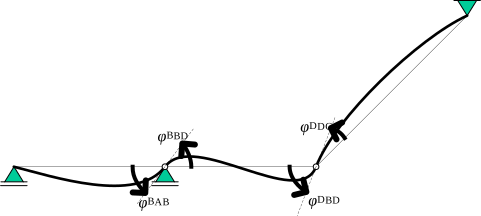
The deformations due to bending can be sketched as follows
Deformation due to bending
These rotations can be found using the forget-me-nots and the rotations of each of the elements due to the rigid body rotations:
φ B A B = M B ⋅ 4 3 ⋅ 20000 → φ B A B = M B ⋅ 2 30000 \varphi _{\rm{B}}^{{\rm{AB}}} = \cfrac{M_\text{B}\cdot 4}{3\cdot 20000} \to \varphi _{\rm{B}}^{{\rm{AB}}} = \cfrac{M_\text{B}\cdot 2}{30000} φ B AB = 3 ⋅ 20000 M B ⋅ 4 → φ B AB = 30000 M B ⋅ 2 φ B B D = − M B ⋅ 4 3 ⋅ 20000 − M D ⋅ 4 6 ⋅ 20000 − 20 ⋅ 4 3 24 ⋅ 20000 − θ → φ B B D = − M B ⋅ 2 30000 − M D 30000 − 1 375 − θ \varphi _{\rm{B}}^{{\rm{BD}}} = -\cfrac{M_\text{B}\cdot 4}{3\cdot 20000} - \cfrac{M_\text{D}\cdot 4}{6\cdot 20000} - \cfrac{20 \cdot 4^3}{24 \cdot20000} - \theta \to \varphi _{\rm{B}}^{{\rm{BD}}} = -\cfrac{M_\text{B}\cdot 2}{30000} - \cfrac{M_\text{D}}{30000} - \cfrac{1}{375} - \theta φ B BD = − 3 ⋅ 20000 M B ⋅ 4 − 6 ⋅ 20000 M D ⋅ 4 − 24 ⋅ 20000 20 ⋅ 4 3 − θ → φ B BD = − 30000 M B ⋅ 2 − 30000 M D − 375 1 − θ φ D B D = M B ⋅ 4 6 ⋅ 20000 + M D ⋅ 4 3 ⋅ 20000 + 20 ⋅ 4 3 24 ⋅ 20000 − θ → φ D B D = M B 30000 + M D ⋅ 2 30000 + 1 375 − θ \varphi _{\rm{D}}^{{\rm{BD}}} = \cfrac{M_\text{B}\cdot 4}{6\cdot 20000} + \cfrac{M_\text{D}\cdot 4}{3\cdot 20000} + \cfrac{20 \cdot 4^3}{24 \cdot20000} - \theta \to \varphi _{\rm{D}}^{{\rm{BD}}} = \cfrac{M_\text{B}}{30000} + \cfrac{M_\text{D}\cdot 2}{30000} + \cfrac{1}{375} - \theta φ D BD = 6 ⋅ 20000 M B ⋅ 4 + 3 ⋅ 20000 M D ⋅ 4 + 24 ⋅ 20000 20 ⋅ 4 3 − θ → φ D BD = 30000 M B + 30000 M D ⋅ 2 + 375 1 − θ φ D D C = − M D ⋅ 4 2 3 ⋅ 20000 2 + θ → φ D D C = − M D ⋅ 2 30000 + θ \varphi _{\rm{D}}^{{\rm{DC}}} = - \cfrac{M_\text{D}\cdot 4 \sqrt{2}}{3\cdot 20000 \sqrt{2}} + \theta \to \varphi _{\rm{D}}^{{\rm{DC}}} = -\cfrac{M_\text{D}\cdot 2}{30000} + \theta φ D DC = − 3 ⋅ 20000 2 M D ⋅ 4 2 + θ → φ D DC = − 30000 M D ⋅ 2 + θ Solve statically indeterminate structure with compatibility conditions and equilibrium ¶ The statically indeterminate forces and unknown rigid body rotation θ can now be solved. However, with only two compatibility conditions an additional equation is needed. This follows from equilibrium, in which the virtual work formulation is most efficient. Therefore, the mechanisms can be reused:
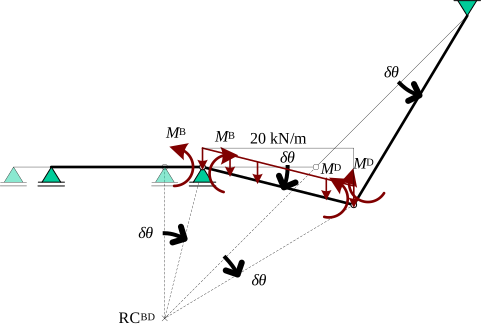
Mechanism for virtual work calculation
This leads to the virtual work equations: δ A = 0 → M B ⋅ δ θ + 20 ⋅ 4 ⋅ 2 δ θ − M D ⋅ δ θ − M D ⋅ δ θ = 0 → M B + 160 − 2 M D = 0 \delta A = 0 \to {M_{\rm{B}}} \cdot \delta \theta + 20 \cdot 4 \cdot 2\delta \theta - {M_{\rm{D}}} \cdot \delta \theta - {M_{\rm{D}}} \cdot \delta \theta = 0 \to {M_{\rm{B}}} + 160 - 2{M_{\rm{D}}} = 0 δ A = 0 → M B ⋅ δ θ + 20 ⋅ 4 ⋅ 2 δ θ − M D ⋅ δ θ − M D ⋅ δ θ = 0 → M B + 160 − 2 M D = 0
The compatibility conditions are as follows:
φ B A B = φ B B D → M B ⋅ 2 30000 = − M B ⋅ 2 30000 − M D 30000 − 1 375 − θ → M B ⋅ 4 30000 + M D 30000 + 1 375 + θ = 0 \varphi _{\rm{B}}^{{\rm{AB}}} = \varphi _{\rm{B}}^{{\rm{BD}}} \to \cfrac{M_\text{B}\cdot 2}{30000} = -\cfrac{M_\text{B}\cdot 2}{30000} - \cfrac{M_\text{D}}{30000} - \cfrac{1}{375} - \theta \to \cfrac{M_\text{B}\cdot 4}{30000} + \cfrac{M_\text{D}}{30000} + \cfrac{1}{375} + \theta = 0 φ B AB = φ B BD → 30000 M B ⋅ 2 = − 30000 M B ⋅ 2 − 30000 M D − 375 1 − θ → 30000 M B ⋅ 4 + 30000 M D + 375 1 + θ = 0 φ D B D = φ D D C → M B 30000 + M D ⋅ 2 30000 + 1 375 − θ = − M D ⋅ 2 30000 + θ → M B 30000 + M D ⋅ 4 30000 + 1 375 − 2 θ = 0 \varphi _{\rm{D}}^{{\rm{BD}}} = \varphi _{\rm{D}}^{{\rm{DC}}} \to \cfrac{M_\text{B}}{30000} + \cfrac{M_\text{D}\cdot 2}{30000} + \cfrac{1}{375} - \theta = -\cfrac{M_\text{D}\cdot 2}{30000} + \theta \to \cfrac{M_\text{B}}{30000} + \cfrac{M_\text{D}\cdot 4}{30000} + \cfrac{1}{375} - 2\theta = 0 φ D BD = φ D DC → 30000 M B + 30000 M D ⋅ 2 + 375 1 − θ = − 30000 M D ⋅ 2 + θ → 30000 M B + 30000 M D ⋅ 4 + 375 1 − 2 θ = 0 Solving these 3 equations gives:
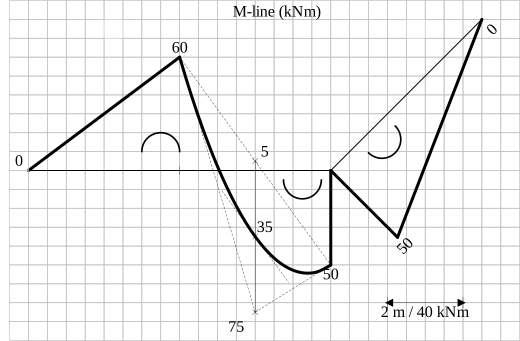
M B = − 60 kNm M_\text{B} = -60 \text{ kNm} M B = − 60 kNm M D = 50 kNm M_\text{D} = 50 \text{ kNm} M D = 50 kNm θ = 11 3000 ≈ 0.0036667 rad \theta = \cfrac{11}{3000} \approx 0.0036667 \text{ rad} θ = 3000 11 ≈ 0.0036667 rad Section force diagrams ¶ Given the solved moments, and 1 8 ⋅ 20 ⋅ 4 2 = 40 kNm \cfrac{1}{8}\cdot20\cdot4^2 = 40 \text{ kNm} 8 1 ⋅ 20 ⋅ 4 2 = 40 kNm
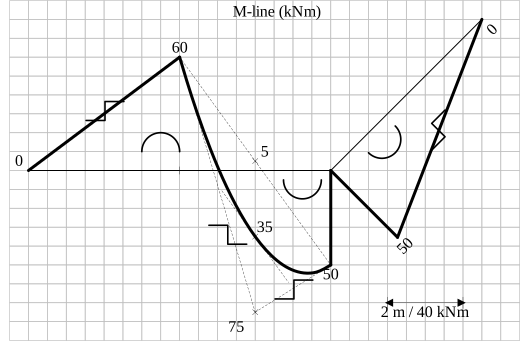
The deformation signs for the shear forces follow from the M-line
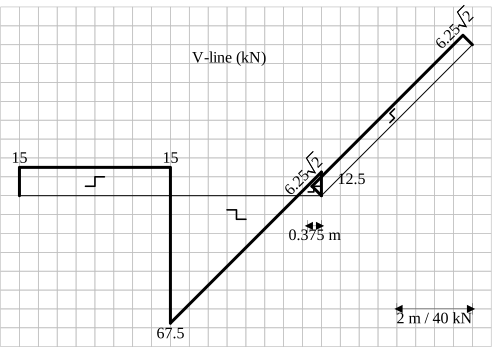
And the sloped give the shear forces themselves:
V AB = 60 4 = 15 kN V_\text{AB} = \cfrac{60}{4}= 15 \text{ kN} V AB = 4 60 = 15 kN V B BD = 60 + 75 2 = 67.5 kN V_{\text{B}}^{\text{BD}} = \cfrac{60+75}{2} = 67.5 \text{ kN} V B BD = 2 60 + 75 = 67.5 kN V D = 75 − 50 2 = 12.5 kN V_\text{D} = \cfrac{75-50}{2} = 12.5 \text{ kN} V D = 2 75 − 50 = 12.5 kN V DC = 50 4 2 = 6.25 2 kN V_\text{DC} = \cfrac{50}{4\sqrt{2}} = 6.25\sqrt{2} \text{ kN} V DC = 4 2 50 = 6.25 2 kN The intersection of the V-line with 0, which coincides with the maximum moment can be found with 7.5 20 = 0.375 m \cfrac{7.5}{20} = 0.375 \text{ m} 20 7.5 = 0.375 m
This leads to the following shear line:
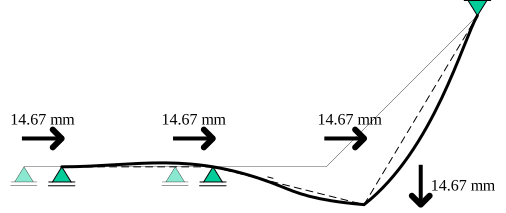
Displacements ¶ The nodal displacement can be found using the rigid body deformations:
u x , A = 11 3000 ⋅ 4 = 11 750 ≈ 0.01467 m u_{x,\text{A}} = \cfrac{11}{3000} \cdot 4 = \cfrac{11}{750} \approx 0.01467 \text{ m} u x , A = 3000 11 ⋅ 4 = 750 11 ≈ 0.01467 m u x , B = 11 3000 ⋅ 4 = 11 750 ≈ 0.01467 m u_{x,\text{B}} = \cfrac{11}{3000} \cdot 4 = \cfrac{11}{750} \approx 0.01467 \text{ m} u x , B = 3000 11 ⋅ 4 = 750 11 ≈ 0.01467 m u x , D = 11 3000 ⋅ 4 = 11 750 ≈ 0.01467 m u_{x,\text{D}} = \cfrac{11}{3000} \cdot 4 = \cfrac{11}{750} \approx 0.01467 \text{ m} u x , D = 3000 11 ⋅ 4 = 750 11 ≈ 0.01467 m u z , D = 11 3000 ⋅ 4 = 11 750 ≈ 0.01467 m u_{z,\text{D}} = \cfrac{11}{3000} \cdot 4 = \cfrac{11}{750} \approx 0.01467 \text{ m} u z , D = 3000 11 ⋅ 4 = 750 11 ≈ 0.01467 m This, together with the given direction of curvatures from the M-line gives the following displaced structure: