... using equilibrium in a specific cross-section
There are two methods which can be applied. In general, it is advised to first solve for the support reactions and identify zero-force members.
Method of joints
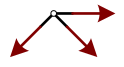
This method investigates free-body-diagrams of individual joints and uses force equilibrium of a particle to solve the section forces. It is treated in chapter 9.3.2 of the book Engineering Mechanics Volume 1 Hartsuijker & Welleman, 2006.
Exercises
- If you’re a TU Delft student, you can practise with the following
 exercises
 - Exercises in chapter 9.4 of the book Engineering Mechanics Volume 1 Hartsuijker & Welleman, 2006, answers are available on this website: 9.58 - 9.80
Method of sections
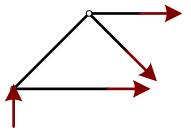
This method investigates free-body-diagrams of parts of the structure and uses force and moment equilibrium to solve the section forces. It is treated in chapter 9.3.2 of the book Engineering Mechanics Volume 1 Hartsuijker & Welleman, 2006.
Exercises
- If you’re a TU Delft student, you can practise with the following exercises
- Exercises in chapter 9.4 of the book Engineering Mechanics Volume 1 Hartsuijker & Welleman, 2006, answers are available on this website: 9.7-9.57
General exercises
The following exercises can be made with any method of your liking:
- If you’re a TU Delft student, you can practise with the following exercises
- Exercises in chapter 9.4 of the book Engineering Mechanics Volume 1 Hartsuijker & Welleman, 2006, answers are available on this website: 9.93 - 9.103
- Hartsuijker, C., & Welleman, J. W. (2006). Engineering mechanics: Volume 1: Equilibrium. In Engineering Mechanics: Volume 1: Equilibrium. Springer Dordrecht. 10.1007/978-1-4020-5483-9