Supports
Supports are treated in the book Engineering Mechanics Volume 1 in chapter 4.3 Hartsuijker & Welleman (2006). Support can be made in any direction, connecting to a horizontal, vertical or sloped environment, as shown in figure Figure 1.
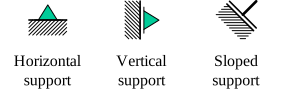
Figure 1:Direction of supports
At Delft University of Technology, supports are indicated using the letter indicating the point next to the symbol, as shown in figure Figure 2. Point are label alphabetically starting with all the support.

Figure 2:Labelling of supports
The degrees of freedom for planar structures are indicated with , the point for which this degree of freedom applies as a subscript and the direction in which it works: , and φ. For three-dimensional structures this leads to , , , , , . Rotation are typical indicated using curved arrow, although double arrows are an option as well. This is shown in figure Figure 3.
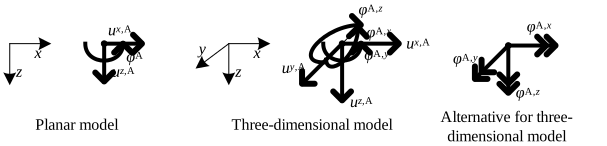
Figure 3:Degrees of freedom at supports
Support reactions for planar structures are indicated with the letter and a , or for horizontal, vertical or rotational loads. Typically, these direction don’t have to align with the coordinate system but are chosen in the expected direction. For three-dimensional structures, the support reactions are indicated with the letter and a x, y, z for the direction. Typically, no moments at support reactions are asked for in three-dimensional problems. This is shown in figure Figure 4.
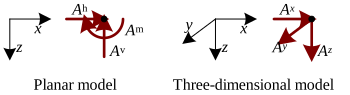
Figure 4:Support reactions
Fixed support

Fixed supports are treated in the book Engineering Mechanics Volume 1 in chapter 4.3.4 Hartsuijker & Welleman (2006).
Hinged support

Fixed supports are treated in the book Engineering Mechanics Volume 1 in chapter 4.3.3 Hartsuijker & Welleman (2006).
Rolling hinged support

Bar supports are treated in the book Engineering Mechanics Volume 1 in chapter 4.3.2 Hartsuijker & Welleman (2006).
Bar support

Bar supports are treated in the book Engineering Mechanics Volume 1 in chapter 4.3.1 Hartsuijker & Welleman (2006).
Rolling clamped support
A rolling clamped support is a connection which allows for transverse movement, but restricts perpendicular movement and rotation. This leads to a support reactions in as shown in figure Figure 9.
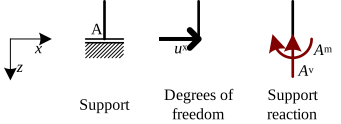
Figure 9:Rolling clamped support
Support displacement

Instead of a prescribed displacement of 0, a support might have a prescribed non-zero displacement. The prescribed displacement leads to a support reaction in that direction too.
- Hartsuijker, C., & Welleman, J. W. (2006). Engineering mechanics: Volume 1: Equilibrium. In Engineering Mechanics: Volume 1: Equilibrium. Springer Dordrecht. 10.1007/978-1-4020-5483-9